A 28-Year-Old Trader Hid £827 Million in Losses in an Account Numbered 88888. Britain's Oldest Bank Sold for £1.
Nick Leeson was both Barings' head trader and head of settlements in Singapore, checking his own work by design. The Bank of England's own inquiry called it a total failure of controls.

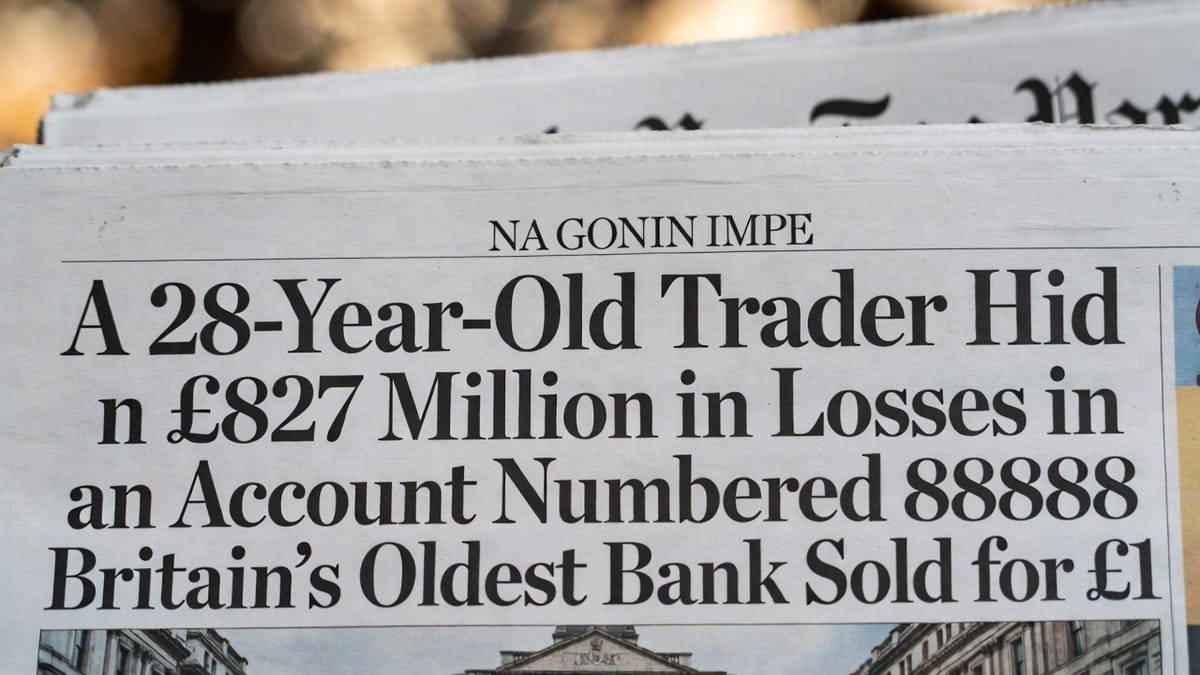
On February 26, 1995, Barings — Britain's oldest merchant bank, financier of the Napoleonic Wars-era British government and the 1803 Louisiana Purchase — was declared insolvent after a single 28-year-old trader in its Singapore office lost £827 million on unauthorized derivatives bets, more than twice the bank's entire available capital. The following day, the Bank of England, having failed to organize a rescue, watched Barings get sold to the Dutch bank ING for a token £1, which took on all of its liabilities along with it.
The trader, Nick Leeson, hadn't beaten any sophisticated risk system. He simply held two jobs the bank should never have let one person hold at once: head trader on the Singapore exchange floor, and head of the back-office settlements desk that was supposed to check his trades. He was, in effect, checking his own work.
The Account Numbered for Luck
Barings had opened error account "88888" in 1992 — eight is considered a lucky number in Chinese numerology — to quietly absorb a junior trader's roughly £20,000 mistake without it appearing on the official books. Leeson kept the account and began routing his own losing trades into it instead of reporting them.
- By December 1994, account 88888 was concealing losses of roughly S$373 million in unauthorized positions on Nikkei 225 futures and options.
- Leeson's dual role meant he confirmed his own trades, reconciled his own accounts, and reported his own results — the exact separation of front-office and back-office duties that banking risk controls exist to enforce, simply didn't exist for him.
- Barings' London management wired Leeson's Singapore operation additional margin funding to cover the account's growing demands, apparently without asking what, specifically, was generating them.
The Kobe Earthquake
On January 17, 1995, an earthquake struck Kobe, Japan, and the Nikkei 225 index dropped sharply in the aftermath. Leeson, already carrying large concealed losses, doubled down — buying more Nikkei futures on the bet that the market would rebound, and selling options that would only pay off if the index stayed calm. The market didn't cooperate. Losses that had taken two years to reach roughly £200 million tripled to £827 million in the six weeks that followed.
233 Years, Gone in a Weekend
Barings had survived the Napoleonic Wars, financed France's sale of the Louisiana Territory to the United States for a 12.5 percent profit margin, and helped refinance the Bank of England itself in 1839. It did not survive Leeson's final week.
- February 23, 1995: Leeson left a note reading "I'm sorry" and fled Singapore, traveling through Malaysia and Thailand before making his way toward Europe.
- February 26, 1995: With losses confirmed at £827 million, Barings was declared insolvent.
- February 27, 1995: Barings was sold to ING for £1, ending 233 years as an independent institution.
- March 2, 1995: Leeson was arrested at Frankfurt Airport on an international warrant.
The Report Nobody Wanted to Write
The UK's Board of Banking Supervision published its inquiry into the collapse on July 18, 1995. Its conclusion was blunt: the disaster reflected "a virtual total failure of risk management systems and controls" across Barings Group, not a single bad actor operating undetected. The lack of segregation between Leeson's trading and settlement roles — the most basic control in any trading operation — had been structural, not accidental, and had gone uncorrected by both Barings' own management and the Bank of England's supervisory arrangements.
What Happened to Leeson
Leeson was transferred to Singaporean custody in November 1995, and in December 1995 pleaded guilty to deceiving Barings' auditors and cheating the Singapore exchange. He was sentenced to six and a half years in a Singapore prison. While incarcerated, he was diagnosed with colon cancer; he was granted early release and returned to the UK in July 1999, having served four years and four months. He later became CEO of an Irish football club, Galway United.
The Board of Banking Supervision's report ran to hundreds of pages diagnosing exactly which controls had failed and why. Leeson's sentence for causing the failure was shorter than the seven years the accounts had gone unchecked, and he served barely half of that. Barings' 233 years of institutional history were worth precisely £1 by the time anyone outside Singapore's settlements desk was allowed to add up what account 88888 actually contained.
Filed from public reporting:
- Britannica — Bankruptcy of Barings Bank (1995)
- Reserve Bank of Australia Bulletin — Implications of the Barings Collapse for Bank Supervisors
- National Library Board Singapore — Barings Bank Collapses From Nick Leeson's Losses
- National Library Board Singapore — Collapse of Barings
- MoneyWeek — 26 February 1995: Nick Leeson Breaks Barings Bank
- Gulf News — December 2, 1995: Whiz-Kid Trader Nick Leeson Jailed
- UK Parliament Hansard — Barings, House of Commons, 18 July 1995
- Bank of England — Court of Directors Minutes, July–December 1995
- Wikipedia — Nick Leeson
- CBS News — Rogue Trader Returns Home


