At Least 34 Former German Lawmakers Went Straight Into Lobbying After Leaving the Bundestag. There's Still No Law Stopping Them.
Germany's insurance lobby alone spent €15.29 million influencing federal policy last year, filed correctly and on time. What the register still doesn't track is where the lawmakers go next.

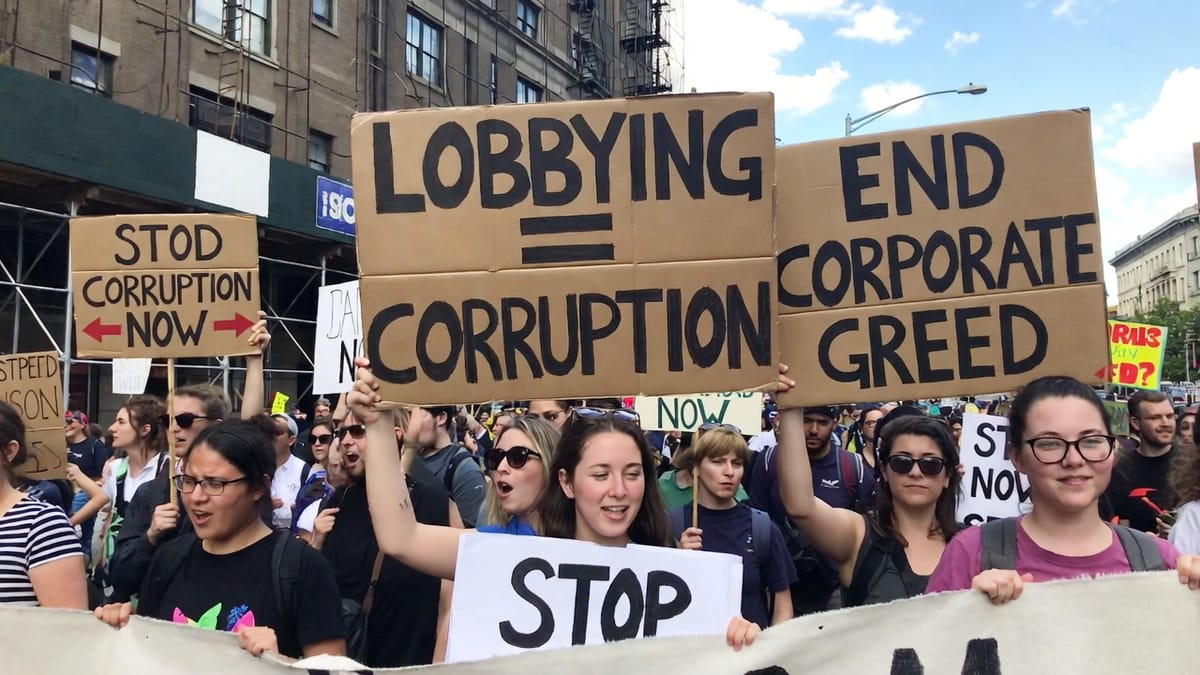
In 2025, Germany's insurance industry association spent more money lobbying the federal government than any other single organization in the country — at least €15.29 million, according to the Bundestag's own public lobby register. The auto industry's trade association spent nearly €10 million, up 35 percent from the year before. None of that is illegal, secret, or particularly hidden: by law, it is all logged in a searchable public database anyone can look up by company name.
What isn't logged, restricted, or subject to any waiting period is what the lawmakers those lobbyists are courting do the day after they leave office. A member of the Bundestag can vote on a bill on a Thursday and start drafting position papers for the industry it regulates the following Monday — legally, immediately, and, as one satirical news program has spent the better part of a decade documenting, frequently.
The Frontex Files
In 2021, Jan Böhmermann's ZDF Magazin Royale, working with the transparency platform Frag den Staat and reporters Luisa Izuzquiza, Margarida Silva, and Myriam Douo, obtained 142 internal documents covering 16 meetings the EU border agency Frontex had held with the arms and security industry between 2017 and 2019. Attendees included the Austrian handgun manufacturer Glock, the aircraft maker Airbus, and Heckler & Koch. Handgun catalogues were passed around the table; surveillance-drone pitches were delivered by PowerPoint. No outside observers were present, and none of it had been disclosed.
- In the 2017 meetings, 58 percent of industry attendees were not listed in the EU's own voluntary transparency register.
- By the 2018–2019 meetings, that figure had risen to 72 percent — despite Frontex's prior public claim that it only met with registered lobbyists.
- The full document set was published as a standalone searchable database, Frontex Files, so the meetings Frontex hadn't disclosed became permanently disclosed anyway.
A Game Called Lobby Memory
In 2022, the same production team partnered with Die Zeit and the transparency nonprofit abgeordnetenwatch.de on a months-long investigation into what happens to members of the Bundestag after they lose their seats. Of 293 lawmakers who had left parliament during or after the most recent legislative period, the team found at least 34 had gone into paid lobbying work — among them former Vice Chancellor Sigmar Gabriel and former CDU General Secretary Peter Tauber. The segment closed with its own punchline built as a prop: a physical memory-matching game pairing former MPs with the lobbying jobs they'd landed, because nothing in German law was doing that matching for free.
The BSI Affair
In October 2022, Böhmermann accused Arne Schönbohm, then president of Germany's federal cybersecurity agency, the BSI, of maintaining "conscious contacts" to circles of Russian intelligence through an industry association he had co-founded, the Cyber-Sicherheitsrat Deutschland. The government suspended Schönbohm within days. He sued ZDF for an injunction and more than €100,000 in damages.
In June 2026, the Munich Higher Regional Court ruled that Böhmermann's central claim was a false statement of fact and ordered ZDF to stop repeating it. It denied Schönbohm any money — not, as is often assumed, because satire carries some blanket immunity from findings of fact, since the court found this specific claim both false and unprotected. It denied damages because Schönbohm had delayed seeking an injunction long enough to miss any chance of stopping his own dismissal, and because his own lawyer had since made public statements, which ZDF disputed, claiming the broadcaster had privately conceded the Russia claim was true — statements the court found he'd made without need and to his own cost. He won the finding that he'd been defamed. He got nothing for it.
The Committee That Went to Australia
In 2023, the program turned to parliamentary committee travel — the foreign trips lawmakers take, officially, to inform legislation. That February, a delegation from the Bundestag's food and agriculture committee, spanning the SPD, CDU, AfD, and FDP, flew to Australia on an itinerary built in cooperation with the Deutscher Forstwirtschaftsrat, a lobbying association representing roughly 200,000 private and public forest owners. The trip's organizer, CDU committee member Josef Rief, and the Forstwirtschaftsrat's president, Georg Schirmbeck, had once sat in the same parliamentary faction together. One stayed a lawmaker. The other became his hosts.
The E-Fuels Exception
The clearest recent case of lobbying converting directly into law didn't come from a Böhmermann segment at all — it came from LobbyControl's own monitoring of Germany's fight to keep combustion-engine cars alive in Brussels.
- In 2021, the mineral oil trade association UNITI launched "E-Fuels for Future," a public campaign promoting synthetic fuel as a climate solution — hiring actors through job listings for protest photos and running gas-station banner ads that didn't disclose who was paying for them.
- Between May 2022 and February 2024, mineral oil industry lobbyists visited Germany's Federal Transport Ministry 18 times, including in-person meetings with Transport Minister Volker Wissing.
- In spring 2024, Wissing and FDP leader Christian Lindner posed for photos holding UNITI's anti-combustion-ban placards at the party's spring conference. Weeks later, UNITI donated €50,000 to the FDP — on top of €82,000 the association had already given the FDP and CDU in 2021 and 2022.
- Wissing went on to block an EU compromise on phasing out combustion-engine car sales that had already been negotiated, winning a last-minute exemption for vehicles that run on e-fuels.
A Register With No Teeth
Germany's federal lobby register has existed since January 2022 and now lists more than 6,000 organizations and individuals. Since the Bundestag administration took over enforcement in 2024, it has opened 83 proceedings — 39 over failures to register at all, 44 over incomplete or inaccurate disclosures. As of its June 2026 accounting, fines had been issued in 13 of them, capped by law at €50,000 per violation, or €100,000 for repeat offenders.
One of those 83 cases involves the Stiftung Familienunternehmen, a lobby group for family-owned businesses. In October 2025, Frag den Staat reported that Economics Minister Katherina Reiche had personally advised the foundation on lobbying strategy around exit taxation for wealthy individuals moving assets abroad — a policy area the foundation had never listed in its register entry. Only after the story ran did the foundation update its filing. It now faces a fine of up to €50,000 for the months it spent lobbying on the issue without saying so.
Nothing in the register touches what happens after a lawmaker leaves office. Germany's only cooling-off rule — 12 to 18 months — has applied since 2015 to former ministers and state secretaries alone, never to the Bundestag's much larger pool of rank-and-file members. LobbyControl has been collecting signatures for a three-year version since 2007; it delivered more than 42,000 of them to parliament and testified at a Bundestag hearing on the subject in August 2022. The bill that hearing was held for has not become law.
The insurance industry's lobbyists don't need to hide anything; €15.29 million a year is right there in the register, filed correctly, on time. The mineral oil industry needed eighteen ministry meetings and one photo op to help buy a legal exemption for the fuel that keeps its product relevant. The Forstwirtschaftsrat needed a shared party faction from a decade earlier and a plane ticket. Thirty-four former lawmakers needed nothing at all — just an unlocked door on their way out, which remains the one part of the entire system nobody in the Bundestag has gotten around to registering.
Filed from public reporting:
- turi2 — "ZDF Magazin Royale": Frontex verheimlichte Lobby-Treffen
- Frontex Files — the published document database
- abgeordnetenwatch.de — Diese Ex-Abgeordneten arbeiten heute als Lobbyisten
- Legal Tribune Online — Böhmermann hat falsch berichtet, muss aber nichts zahlen
- heise online — BSI Affair: Ruling Against Böhmermann's ZDF Magazin Royale Confirmed
- Forstpraxis — Böhmermann-Bericht: Steuer-Sonderfall im Wald der Familie von Bismarck
- LobbyControl — E-Fuels: Dreiste Lobbykampagne gegen das Verbrenner-Aus
- LobbyControl — Verbrennerlobby nutzt privilegierten Zugang zur Ministeriumsspitze
- LobbyControl — 7 zu 84: Übermacht der Wirtschaftslobby wächst weiter
- Deutscher Bundestag — Bußgeldverfahren-Statistik, Lobbyregister
- Frag den Staat — Milliardärs-Lobby droht Bußgeld
- LobbyControl — Karenzzeit: Unterschriftenübergabe und Anhörung im Bundestag


