Battlefield 6 Sold 7 Million Copies in Three Days. Four Months Later, EA Laid Off the Studios That Made It.
Battlefield 6 sold seven million copies in three days. It was the biggest launch in the franchise's history, the best-selling premium video game of 2025, and by every metric EA uses to justify a bonus, an unambiguous win. Four months later, EA laid off staff across all four studios that built it.

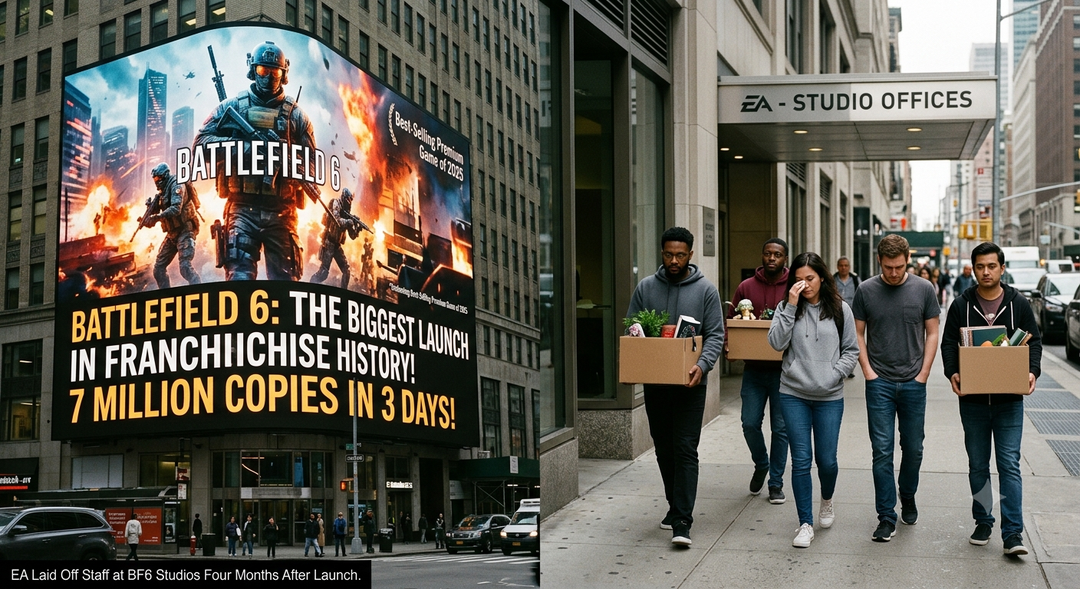
Battlefield 6 sold seven million copies in three days. It was the biggest launch in the franchise's history, the best-selling premium video game of 2025, and by every metric EA uses to justify a bonus, an unambiguous win. Four months later, EA laid off staff across all four studios that built it.
This is not a story about one bad quarter at one publisher. It's a pattern with a name in the industry — "ship and gut" — and the paperwork behind it is public.
The Battlefield 6 Timeline
Battlefield 6 launched October 10, 2025, built across four EA-owned studios: DICE, Criterion Games, Ripple Effect, and Motive. It shattered records out of the gate — seven million copies in three days, the franchise's best launch ever, and the best-selling premium game in the US for all of 2025 according to Circana.
On March 9, 2026, EA announced layoffs across all four studios. The company called it a "realignment," saying in a statement that it had "made select changes within our Battlefield organization to better align our teams around what matters most to our community." The number of people affected was never disclosed by EA; reporting put the Battlefield division's cuts at roughly 300 jobs. It was the second round of EA layoffs in two months — the company had already cut staff at Skate developer Full Circle in February.
Weeks after the Battlefield cuts, EA's board set CEO Andrew Wilson's total compensation for fiscal 2026 at $38,649,984 — up $8.1 million, a 27% raise over his $30.5 million the year before. The board's own justification cited Battlefield 6 hitting "all milestones for a high-quality launch" and strong performance from EA Sports FC. The raise was paid, in other words, explicitly for the work of the people who had just been laid off for having done it.
Under a separate SEC pay-ratio disclosure, Wilson's compensation works out to roughly 305 times what EA's median employee makes — reported at $126,612 a year. His "compensation actually paid" figure, a separate SEC metric that marks unvested equity to market, came in even higher: $77.2 million. He's also entitled to up to $125 million in severance if terminated during EA's pending $55 billion take-private acquisition by a Saudi Public Investment Fund-led consortium — a deal that, if it closes, hands PIF a 93.4% stake in the company that just laid off the people who made its best-selling game.
It's Not Just EA
The Battlefield 6 timeline reads like an outlier only if you haven't been paying attention. The same shape — ship it, sell it, cut the people who built it, raise the person who didn't — shows up across the industry, on a cycle of months, not years.
Take-Two, 2023–2024. In February 2024, CEO Strauss Zelnick told Variety the company had "no current plans for layoffs." Two months later, Take-Two cut 600 jobs — about 5% of its workforce — and shut down two studios outright: Roll7, the British developer behind the critically acclaimed OlliOlli World and Rollerdrome, and Seattle's Intercept Games. Zelnick's total compensation that year rose from $16 million to $42 million, a $26 million increase; combined with president Karl Slatoff, the two executives took home $72.3 million, more than double their prior-year pay, built substantially from performance-based stock tied to "recurrent consumer spending." Critics inside and outside the company noted that the raise alone was larger than what it would have cost to keep both closed studios running.
Activision Blizzard, 2022. CEO Bobby Kotick came due a "shareholder value creation incentive" bonus worth up to $200 million, tied to a stock-price clause written years earlier, around the same period the company cut close to 200 jobs from its esports and live-events divisions. CtW Investment Group, a shareholder advocacy fund, wrote to the board that the company's stock gains "alone does not justify such a substantial pay outcome for the CEO."
Microsoft / Xbox, 2025–2026. Microsoft's fiscal 2025 was record-setting company-wide — CEO Satya Nadella's total pay rose to $96.5 million, up 22%, credited to the company's AI push. The same fiscal year, Microsoft cut over 15,000 jobs globally. Xbox took some of the deepest hits: a July 2025 round eliminated the Perfect Dark reboot and closed The Initiative studio outright, alongside cuts at King, ZeniMax, and Turn 10. A second wave in mid-2026 pushed the division's total reduction to roughly 3,200 jobs — around 20% of Xbox's global workforce — while the company as a whole posted $31.8 billion in quarterly net income, up 23% year over year. Xbox's own division reportedly closed the year near a 3% profit margin, short of a company-wide 30% target set from outside the gaming business — the games didn't fail; they were held to a bar unrelated to whether they worked.
The Mechanism, Not a Coincidence
None of this requires bad intentions from any single executive to explain. It requires understanding what a game studio's headcount is actually for, on the org chart that a public company's board is looking at.
A launch team is a cost center that becomes hardest to justify the moment it succeeds. Once a game ships and the pipeline of new content, patches, and features is defined, several hundred people whose job was "make the thing that doesn't exist yet" are, from a spreadsheet's perspective, no longer needed to keep making the thing that now exists. Live-service and post-launch support takes a fraction of the staff a full production cycle does. The layoff isn't a punishment for failure — it's what a successful launch predictably does to a studio's headcount forecast, on a schedule set by the production calendar, not by how the game performed.
Executive pay runs on an entirely different calendar. Public company compensation committees set CEO pay against annual and multi-year performance targets, evaluated in the fiscal year a hit lands — the same year, sometimes the same board meeting, where the layoffs tied to that hit's post-launch staffing curve get approved. The developer's severance and the CEO's bonus are frequently line items in the same quarter's filings, because they're both downstream of the same launch, moving through the same set of financial mechanisms in opposite directions.
What the Industry Calls It When It's Not Being Quoted
Public statements use words like "realignment," "select changes," and "focus." Inside the industry — on developer forums, in exit interviews, in union organizing literature from groups like the Communication Workers of America's CODE-CWA campaign — the pattern has a blunter name: crunch, ship, cut. Work unsustainable hours to hit a launch date, ship the game, and then be the cost the company trims to book a clean quarter off the thing you just built.
It's a large enough pattern that a Wikipedia-tracked tally counted roughly 14,800 video game industry layoffs in 2024 alone, with over 8,600 in the first quarter — the highest quarterly total on record at the time. Nearly every major publisher appears somewhere on that list: Microsoft, Sony, EA, Riot, Ubisoft, Take-Two, Tencent, Embracer. The Battlefield 6 case isn't an anomaly inside that list. It's the version with the clearest paper trail.
Filed from public reporting:
- Game Developer — EA has laid off an undisclosed number of Battlefield developers
- PC Gamer — After laying off Battlefield 6 developers, EA pays its CEO $38 million because Battlefield 6 did so well
- Yahoo Finance — Despite Battlefield 6 layoffs, EA paid its CEO 305x more than its average employee
- Yahoo Finance — Industry anger over GTA 6 publisher's closure of two acclaimed studios despite CEO's $26 million pay rise
- Game Developer — Take-Two was making layoffs in March, but just paid its top execs $72.3 million
- Yahoo — Fans enraged over gaming company CEO's $200M bonus amid layoffs
- GeekWire — Satya Nadella's pay tops $96M as Microsoft stock soars
- GeekWire — Microsoft cuts jobs, revamps salesforce and launches massive Xbox overhaul
- Wikipedia — List of 2024 gaming industry layoffs


