Blackwater Guards Killed 17 Iraqi Civilians in a Baghdad Traffic Circle in 2007. A Presidential Pardon Erased Their Convictions in 2020.
It took thirteen years, a dismissed indictment, a vacated murder conviction, and two retrials to convict the men who opened fire in Nisour Square. It took one afternoon in 2020 to undo it.

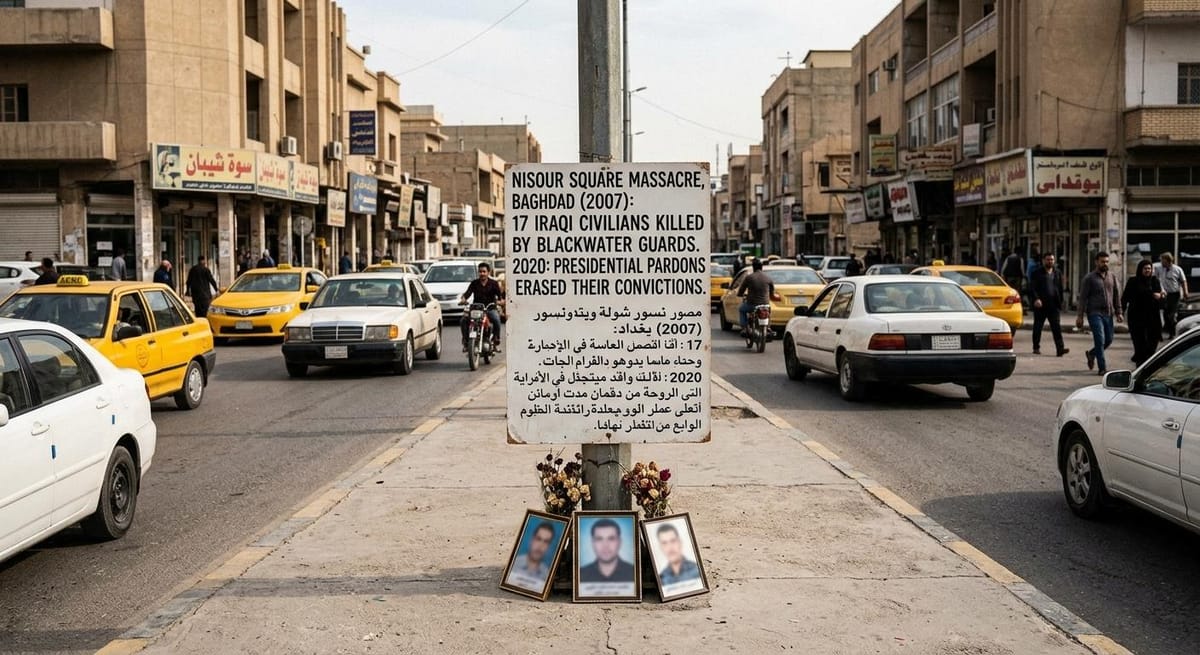
At around noon on September 16, 2007, a 19-man Blackwater USA security team known as Raven 23 drove four armored trucks into Nisour Square in Baghdad to help clear a route for a State Department convoy. Within minutes, the team had opened fire with rifles, machine guns, and grenade launchers into the traffic circle. Seventeen Iraqi civilians were killed and twenty more were wounded. Blackwater said its convoy had been ambushed. Federal prosecutors later said the attack was unprovoked.
The guards were American contractors working for the U.S. State Department on Iraqi soil, which meant that for the first two years after the shooting, the biggest open question wasn't who fired first — it was whether any court on Earth actually had the authority to try them for it.
A Legal No-Man's-Land
Since 2004, Coalition Provisional Authority Order 17 had granted foreign contractors working in Iraq immunity from prosecution under Iraqi law. Nisour Square made that immunity a scandal on its own: Iraq's cabinet voted on October 30, 2007 to formally revoke Order 17, seeking the ability to prosecute Blackwater's guards in its own courts. That effort went nowhere. The case that eventually moved forward did so in Washington, D.C., under the Military Extraterritorial Jurisdiction Act — the same law used to prosecute contractors working for the Defense Department, applied here to contractors who technically worked for State.
The First Case Collapses
Five guards were indicted on manslaughter and weapons charges in December 2008. On December 31, 2009, federal judge Ricardo Urbina dismissed the entire indictment. His 90-page opinion found that prosecutors had built their case on statements the guards gave to State Department investigators under Garrity v. New Jersey protections — testimony compelled under threat of losing their jobs, and therefore inadmissible against them in a criminal case. Urbina wrote that prosecutors, "in their zeal to bring charges," had ignored repeated warnings from their own senior colleagues about using that material. An appeals court later found Urbina had misapplied part of the legal standard and sent the case back in 2011, reviving a prosecution that had already lost two years to dismissal.
Conviction, Vacated, Reconvicted
- June–October 2014: After ten weeks of testimony and 28 days of deliberation, a jury convicts Nicholas Slatten of first-degree murder and convicts Paul Slough, Evan Liberty, and Dustin Heard of voluntary and attempted manslaughter and weapons charges.
- August 4, 2017: The D.C. Circuit Court of Appeals vacates Slatten's murder conviction, ruling the trial court should have granted his motion to be tried separately from his co-defendants and ordering a new trial.
- 2018: Slatten's first retrial ends in a hung jury and a mistrial.
- December 19, 2018: A second retrial convicts Slatten of first-degree murder again.
- September 5, 2019: An appeals court finds the mandatory minimum sentences applied to Slough, Liberty, and Heard unconstitutional in this context; the three are resentenced to roughly half their original 30-year terms.
- August 14, 2019: Slatten is sentenced to life in prison without parole.
The Pardons
On December 22, 2020, President Trump issued a batch of 15 pardons that included all four men: Slatten, Slough, Liberty, and Heard. The White House's statement cited their military and government service records and said "additional evidence" should have been presented at Slatten's trial. The pardons erased convictions that had taken three trials, one dismissal, one appellate reversal, and thirteen years to obtain. The United Nations human rights office publicly criticized the decision, saying it violated the United States' obligations under international law to hold perpetrators of serious human rights violations accountable. One of the pardoned guards, asked afterward whether he had any regrets, said he believed he had acted correctly.
Iraq's government never got the chance to try Raven 23 in its own courts for what happened in its own capital. The country that did try them took thirteen years, three trials, and one vacated conviction to reach a verdict that held — and then reversed all of it in a single afternoon, thanks to the same government whose citizens the guards had been hired to protect their diplomats from.
Filed from public reporting:
- Wikipedia — Nisour Square Massacre
- International Code of Conduct Association — The Nisour Square Massacre
- Human Rights Watch — Iraq: Pass New Law Ending Immunity for Contractors
- The Volokh Conspiracy — All Charges Dismissed Against Blackwater Contractors
- The Washington Post — Judge Ordered to Revisit Blackwater Guard Shooting Case
- U.S. Department of Justice — Former Blackwater Employee Found Guilty of Murder in Fatal 2007 Shooting in Nisur Square, Iraq
- Justia — United States v. Slatten, D.C. Circuit (2017)
- Al Jazeera — Blackwater Four 'Made Corpses of Innocents'
- NPR — Shock and Dismay After Trump Pardons Blackwater Guards Who Killed Iraqi Civilians
- BBC — UN Criticises Trump's Pardons for Blackwater Guards Jailed Over Iraq Killings
- CBS News — Trump Pardons Security Contractors Involved in Baghdad Massacre


