DuPont Knew PFOA Was Showing Up in a Worker's Newborn in 1981. It Took the EPA Twenty-Four Years and a Record Fine to Find Out.
DuPont found its own Teflon chemical in a baby's umbilical cord blood in 1981 and said nothing. The EPA didn't find out for 24 years — and its record fine amounted to about half a day of DuPont's revenue.

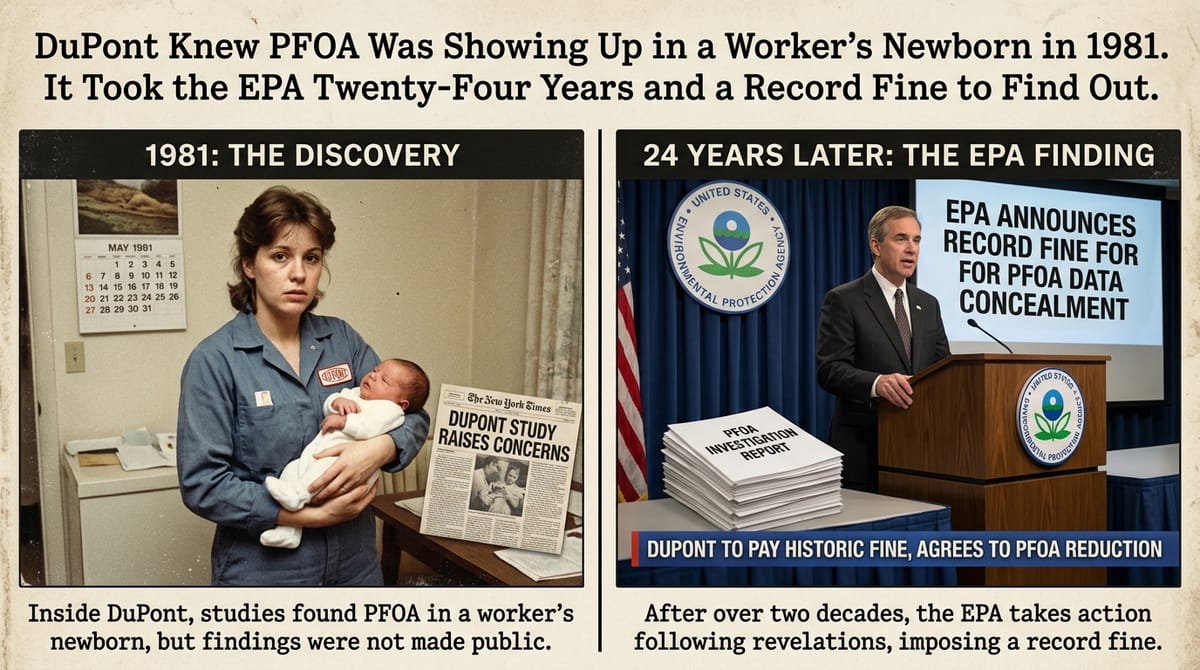
In 1981, DuPont tested blood drawn from seven pregnant employees at its Washington Works plant near Parkersburg, West Virginia, and from their newborns. The chemical it was looking for, C8 (perfluorooctanoic acid), was the processing agent DuPont used to make Teflon. It found C8 in the umbilical cord blood of one baby and in the blood of a second. Two of the seven monitored pregnancies had produced children with birth defects — one with an eye and tear-duct defect, another, a boy named Bucky Bailey, born with only one nostril and facial deformities that required years of surgery to correct.
DuPont's response was to quietly reassign about 50 women out of the plant's exposed jobs that year, without telling most of them why. It did not report the cord-blood findings to the Environmental Protection Agency. That report didn't happen for more than two decades — until the EPA found out on its own and, in December 2005, fined DuPont a record $16.5 million for it, among other violations.
Five Decades on the Ohio River
DuPont used C8 to manufacture Teflon and related products at Washington Works from 1951 until 2012. Between 1951 and 2003 alone, the plant discharged more than 1.7 million pounds of the chemical into the Ohio River, unlined waste ponds, and landfills. C8 does not readily break down in the environment or the human body, and it worked its way into the drinking water of tens of thousands of West Virginia and Ohio residents living near the plant.
- DuPont's own research had shown C8 was toxic in animal studies since at least the 1960s.
- By the 1970s, internal studies had found high concentrations of C8 in the blood of Washington Works employees and established that the chemical crossed the placenta.
- In 1984, internal testing found C8 in Parkersburg's public drinking water at levels up to 0.5 parts per billion. DuPont did not notify the utility or residents.
- A DuPont internal memo from that era recommended eliminating C8 emissions "in a way … which does not economically penalize the business." Production increased instead.
The Farmer and the Lawyer
In 1998, Wilbur Tennant, a cattle farmer whose land bordered a DuPont landfill outside Parkersburg, hired attorney Rob Bilott after hundreds of his cows died, some bleeding from the nose and mouth, after drinking from a creek running off DuPont's property. Bilott, who had spent his career on the corporate defense side of environmental law, filed suit in 1999. DuPont's own discovery production — tens of thousands of pages the company was required to turn over — became the paper trail documenting what the company had known and when. The case became the basis for the 2019 film Dark Waters and a 2016 New York Times Magazine cover story titled "The Lawyer Who Became DuPont's Worst Nightmare."
What the Science Panel Found
A 2004 class-action settlement over the contaminated water supply required DuPont to fund an independent C8 Science Panel, which spent seven years studying roughly 69,000 residents in the affected water districts. Between 2011 and 2012, the panel concluded there was a "probable link" between C8 exposure and six conditions: kidney cancer, testicular cancer, ulcerative colitis, thyroid disease, pregnancy-induced hypertension, and high cholesterol. The settlement that funded the study also cleared the way for roughly 3,550 personal-injury lawsuits, consolidated in federal court in Ohio.
The Payout
DuPont spun off a new company, Chemours, in 2015, transferring ownership of Washington Works and much of the associated liability to it two years before the litigation resolved. In February 2017, DuPont and Chemours agreed to jointly pay $670.7 million — $335.35 million each — to settle the roughly 3,550 personal-injury claims. Rob Bilott, still representing the plaintiffs eighteen years after taking Wilbur Tennant's case, was co-lead counsel.
DuPont's 2005 settlement with the EPA was, at the time, the largest civil administrative penalty the agency had ever collected under any federal environmental statute. It amounted to roughly what the company made in half a day.
Filed from public reporting:
- EPA — EPA Settles PFOA Case Against DuPont for Largest Environmental Administrative Penalty in Agency History
- Environmental Working Group — EPA Finds DuPont Guilty of Withholding Teflon Blood and Water Pollution Studies
- Environmental Working Group — Poisoned Legacy
- e-WV: The West Virginia Encyclopedia — C8 Controversy
- The Intercept — The Teflon Toxin: DuPont and the Chemistry of Deception
- The New York Times Magazine — The Lawyer Who Became DuPont's Worst Nightmare
- Hill, Peterson, Carper, Bee & Deitzler — Findings of the C8 Science Panel Regarding Probable Links
- The Marietta Times — $670 Million C8 Lawsuit Against DuPont Settled
- U.S. Securities and Exchange Commission — Chemours Co. Form 8-K, February 13, 2017
- Environmental Health News — A Lasting Legacy: DuPont, C8 Contamination and the Community of Parkersburg


