Germany Takes Almost Half Your Paycheck Before You See It. The Receipts Include a €5 Million Boat Used for Three Days.
A single German worker on an average salary hands over 46.6 percent of their total labor cost to the state before a euro reaches their account — income tax and social contributions combined, second highest in the OECD, beaten only by Belgium.

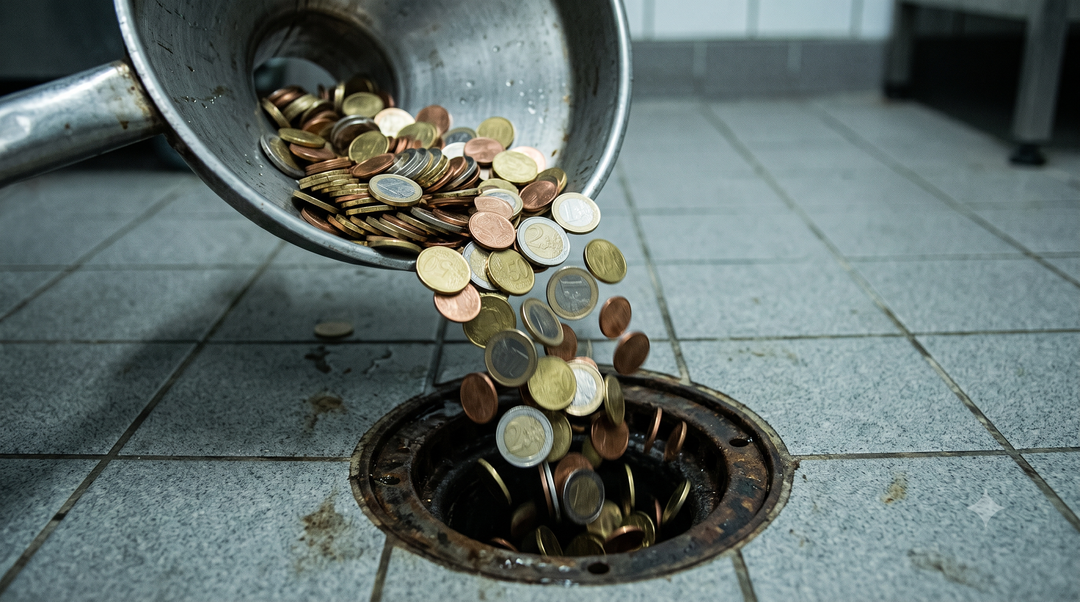
A single German worker on an average salary hands over 46.6 percent of their total labor cost to the state before a euro reaches their account — income tax and social contributions combined, second highest in the OECD, beaten only by Belgium. Layered on top of that: 19 percent VAT on almost everything the after-tax euros buy, a surcharge that was supposed to end in 1995, and a tax on sparkling wine that outlived the navy it was built to pay for.
Germany also has an entire nonpartisan institution whose full-time job is cataloging where the money goes instead. It publishes an annual report. It is never short of material.
The Layers Under the Headline Number
Income tax alone is progressive from 14 percent to 45 percent above roughly €12,096 of tax-free allowance. On top of that sits the Solidaritätszuschlag — the "solidarity surcharge," introduced in 1991 to fund German reunification, still collected in 2025 from the top 10 percent of earners and roughly 500,000 companies, worth €13 billion a year to the federal budget. In March 2025, Germany's Federal Constitutional Court upheld it as constitutional, citing continuing "structural differences" between eastern and western Germany — thirty-five years after the wall came down and one currency replaced two.
Social insurance contributions — health, pension, unemployment, long-term care — add roughly another 20 percent of gross salary, split close to evenly between employee and employer. Members of a recognized church pay an additional 8 to 9 percent church tax on their income tax bill. Then there's consumption: 19 percent VAT standard rate, 7 percent reduced, which alone brought in €310.2 billion in 2025 — more than any other single tax, wage tax included, which raised €262.7 billion. Total tax revenue across every level of German government in 2025: €989.8 billion.
And for a specific kind of joy: anyone buying a bottle of German Sekt is still paying the Schaumweinsteuer, a sparkling-wine tax Kaiser Wilhelm II introduced in 1902 to help fund the Imperial German Navy's arms race with Britain. The Imperial Navy stopped existing in 1919. The tax, currently €1.02 a bottle, did not — Germany is now the last country in the EU still charging it.
An Actual Institution Whose Job Is to Count This
The Bund der Steuerzahler, Germany's taxpayers' federation, publishes an annual "Schwarzbuch" — literally "black book" — of documented public waste, sourced from budgets, freedom-of-information requests, and local reporting. The 2025/26 edition includes, among hundreds of entries:
- A grilling hut ("Grillhütte") in the Westerwald region, originally budgeted as a simple renovation, that became a two-story building costing nearly €1 million, with €105,000 a year in ongoing costs.
- A ship purchased for €5 million and used for three days, before officials determined it couldn't be operated safely.
- Three mobile "green modules" in Mainz costing €100,000, used for a total of five months.
- A synthetic turf soccer field in Hamburg's Oberhafen district, €1.53 million, never used in a single league match — the field turned out to be the wrong size, and no club ever adopted it.
- The Bundestag's own budget, which stayed above €1.2 billion even after a 2023 reform shrank the chamber to 630 seats — partly because each of the now-fewer members gets four offices instead of the previous three.
The Nine- and Ten-Figure Items
Some of the country's waste doesn't fit in a Schwarzbuch bullet point.
Berlin Brandenburg Airport was budgeted at roughly €2.83 billion, scheduled to open in 2011. It opened nine years late, in 2020, at a final cost estimated between €6.5 and €7.3 billion — driven in part by a custom smoke-extraction system that never passed certification as designed.
Hamburg's Elbphilharmonie concert hall was budgeted at €77 million. It opened in 2016, after an 18-month construction halt and a total renegotiation of the contract, at a final cost of €866 million — more than eleven times the original figure.
Berlin's new foreign intelligence headquarters, for the BND, was estimated at €720 million. It came in at roughly €1.1 billion, 42 percent over budget and five years late — a project that also survived a 2010 theft of its own architectural blueprints, forcing a costly mid-construction redesign, and a 2015 break-in in which thieves stole the bathroom taps from Berlin's most secure construction site, flooding it and destroying wiring and equipment on their way out.
When the Waste Has a Name Attached
Not all of it is bureaucratic drift. Some of it has a signature on the invoice.
In 2019, an EU court ruled Germany's planned car-toll system — championed by then-Transport Minister Andreas Scheuer — illegal before it ever collected a euro from a driver. The government still had to pay the contractors it had hired to build it: a €243 million settlement, talked down from an opening demand of €560 million. Scheuer's successor as transport minister said taxpayers shouldn't have to cover the full cost of "this serious political mistake."
During the pandemic, several members of Germany's governing CDU/CSU parties were found to have personally profited from brokering government mask contracts. CDU's Nikolas Löbel resigned after admitting to roughly €250,000 in commissions; CSU's Georg Nüßlein is alleged to have billed around €660,000 for his role as a middleman. The largest volume ran through Andrea Tandler, daughter of a former CSU general secretary, whose firm brokered close to €683 million in mask orders to Bavaria and North Rhine-Westphalia — Bavaria alone paid €8.90 per mask against a going market rate of €3 to €5.99 — for an estimated profit margin, by one newspaper's calculation, of roughly €250 million.
And under then-Defence Minister Ursula von der Leyen, Germany's defense ministry awarded consulting contracts worth several hundred million euros to firms including McKinsey and Accenture, without competitive tendering, in what became known in the Bundestag as the "Berateraffäre." A parliamentary investigation committee reviewed roughly 4,600 files and questioned 41 witnesses over more than a year. It found no proof of illegal conduct, but it did establish that message data from von der Leyen's ministry-issued phone had been deleted before the phone was handed over as evidence — a staff member's doing, according to the ministry's own account to the committee, with a second phone's messages destroyed by von der Leyen herself, according to Der Spiegel's reporting. Von der Leyen said she had no knowledge of the deletion.
One more, for scale: Schleswig-Holstein and the federal government committed roughly €600 million in subsidies to Northvolt, a Swedish battery manufacturer, for a planned factory. Northvolt filed for insolvency before it was built.
The Part That Doesn't Need Embellishing
None of the above required a leak, a whistleblower, or an investigative reporter's year-long dig. It's in a court ruling, a parliamentary committee's own final report, an annual publication that a nonpartisan taxpayers' association puts out precisely because the material never runs dry, and the federal government's own statistics office. A country that takes a bigger cut of the average paycheck than every OECD member except one also maintains, apparently as a permanent fixture, an industry of institutions dedicated to documenting where that cut went instead of where it was supposed to go. The tax wedge is the headline. The Schwarzbuch is the appendix, and it gets longer every year.
Filed from public reporting:
- Tax Foundation Europe — Tax Burden on Labor in Europe, 2026
- Bundesverfassungsgericht — Unsuccessful constitutional complaint against the solidarity surcharge
- Destatis (German Federal Statistical Office) — Tax revenue 2025
- Gerardo.de — The German Fleet Tax (Sektsteuer history)
- Bund der Steuerzahler — Schwarzbuch 2025/2026
- BudgetOverrun.com — Berlin Brandenburg Airport (BER): 9 Years Late, Billions Over Budget
- The Local — €700m over budget, Hamburg concert hall finally finished
- The Irish Times — Mockery greets Berlin's 'megalomaniacal' new spy HQ
- AP via Washington Times — German government wants ex-minister to foot $267 million bill for a failed highway toll plan
- The Local — What you need to know about Germany's face mask scandal
- Der Tagesspiegel — Handydaten gelöscht, obwohl sie als Beweise dienen sollten


