Hooker Chemical Sold a Toxic Waste Dump to a School Board for $1 in 1953. Congress Needed 27 More Years to Write a Law About It.
Hooker Chemical buried 21,000 tons of waste, capped it, and sold it for a dollar with a deed that predicted exactly what would happen next. It took a leaked study and a five-hour hostage standoff to get anyone to act.

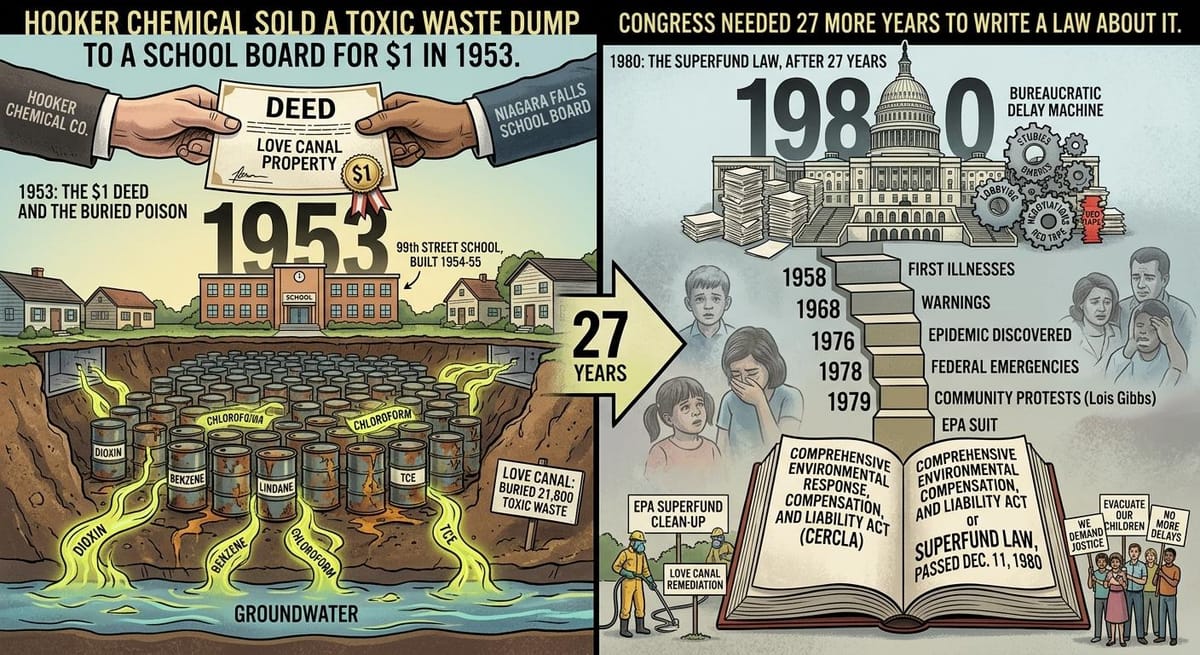
Between 1942 and 1953, the Hooker Chemical Company dumped roughly 21,000 tons of chemical waste, including at least twelve known carcinogens, into an unfinished 19th-century canal excavation in Niagara Falls, New York. In April 1953, with the canal filled and capped, Hooker sold the 16-acre parcel to the Niagara Falls Board of Education for one dollar. The deed included a 17-line disclaimer describing the buried chemicals and warning that the ground shouldn't be disturbed, while releasing Hooker from any future liability for injury or damage the waste might cause.
The school board built an elementary school directly on top of the landfill anyway, and sold the surrounding lots for development. Within a few years, roughly 800 single-family homes and 240 low-income apartments stood around a capped chemical dump, and nobody with regulatory authority over any of it had a legal obligation to go back and check what was underneath.
What Was Actually in the Ground
Later testing by the EPA identified more than 200 distinct chemical compounds in the Love Canal fill, including benzene, dioxin, and chlorinated hydrocarbons left over from decades of industrial production. By the mid-1970s, heavy rains had raised the local water table, and the corroded waste drums began pushing chemical sludge to the surface through basement walls and backyards.
- Residents reported black, oily puddles in yards, chemical odors inside homes, and children returning from play with chemical burns.
- The elementary school built directly on the landfill, 99th Street School, sat above the densest concentration of buried waste.
- Corroding storage drums and eroding soil cover left some of the original 21,000 tons of waste within a few feet of the surface in places.
"I Will Never Be Quiet Again"
In 1978, a 27-year-old homemaker named Lois Gibbs learned her son's elementary school sat on top of the old dump after her son developed epilepsy and other neighborhood children began showing similar patterns of illness. Gibbs organized her neighbors into the Love Canal Homeowners Association and began pushing state and federal officials for testing, health data, and relocation.
- August 7, 1978: President Jimmy Carter declared the first federal emergency in U.S. history for a man-made, non-natural disaster, releasing federal funds to relocate 239 families living in the two rings of homes closest to the former canal.
- Hundreds of families further from the canal's center were left in place, told their homes were not part of the emergency zone, and continued living there.
- New York State's Health Commissioner would later testify that a preliminary internal state study had found evidence of health effects considerably earlier, without it being made public.
The Hostage Negotiation That Worked
In May 1980, results from an EPA pilot study leaked before residents were formally told: it reported that 11 of 36 Love Canal residents tested showed chromosomal abnormalities, a rate the study characterized as far above normal. The study had no control group and was later disputed by other scientists and a 1983 Centers for Disease Control follow-up study, which found no elevated rate of chromosomal damage among Love Canal residents compared to the rest of Niagara County — but in May 1980, the leaked findings triggered a crisis before anyone could sort out whether they were valid.
Gibbs invited two EPA representatives to a town-hall meeting at the Homeowners Association office and residents refused to let them leave, blocking the doors with two-by-fours while Gibbs called the White House and the press. The two officials were held for roughly five hours before being released. Two days later, the White House agreed to temporarily relocate all remaining Love Canal families. On October 1, 1980, Carter signed an appropriations bill funding permanent relocation for the roughly 900 families who wanted to leave, and the 99th Street School and the surrounding blocks were eventually demolished.
The Law That Didn't Exist Yet
When Love Canal became a national story, the federal government had no general-purpose law for identifying abandoned toxic waste sites, assigning cleanup costs, or forcing a responsible company to pay for contamination it caused decades earlier under a valid legal disclaimer. Congressional hearings held in the wake of Love Canal, alongside contamination discoveries at other sites around the country, built the case for closing that gap.
- December 11, 1980: Congress passed the Comprehensive Environmental Response, Compensation, and Liability Act, commonly known as CERCLA or Superfund, creating both a federal cleanup fund and a legal mechanism to make polluters pay retroactively.
- The fund was financed primarily through an excise tax on the chemical and petroleum industries — a "polluter pays" structure directly informed by cases like Love Canal, where a legally binding disclaimer had shielded the original polluter from liability.
- Congress allowed that industry tax to expire in 1995. For the next 27 years, Superfund cleanups were financed mostly by general taxpayer revenue rather than by industry, until the tax was reinstated by the Infrastructure Investment and Jobs Act starting July 1, 2022.
Delisted in 2004
The EPA and New York State completed remediation work — capping the site, installing a leachate collection system and barrier drain — by 1999, and the EPA removed Love Canal from the Superfund National Priorities List in September 2004, certifying that it no longer posed a threat to human health. Part of the former neighborhood was later rebuilt and resold as a subdivision under a new name. Long-term health outcomes for former residents remain scientifically disputed to this day: state and federal reviews found no consistent, statistically significant pattern of birth defects or miscarriage across the studies, even as former residents and Gibbs herself have continued to maintain the data undercounted the harm.
Hooker Chemical's 1953 deed predicted almost exactly what would happen to the site it was selling — the waste, the disturbance, the danger — and used that prediction to protect itself rather than to stop the sale. The company got the liability disclaimer it wanted; the school board got a dollar; the families who moved in over the next two decades got the information last, from a leaked government study delivered by an EPA employee standing in a locked room, twenty-seven years after the ground had first been sealed.
Filed from public reporting:
- SUNY Geneseo — Love Canal: A Brief History
- University at Buffalo — Love Canal: Timeline and Photos
- Center for Health, Environment & Justice — Love Canal
- U.S. EPA — Love Canal Superfund Site Profile
- U.S. EPA — Love Canal Revealed a National Problem; Superfund Provided a Solution
- U.S. EPA — EPA Removes Love Canal From Superfund List (2004)
- New York State Department of Health — Love Canal: Public Health Time Bomb
- Levin Center — Portraits in Oversight: Congress and the Love Canal Disaster
- Timeline / Medium — When a Chemical Company Dumped 21,000 Tons of Toxic Waste, Residents Took EPA Hostages
- Mondaq — The Infrastructure Investment and Jobs Act Reinstates the Superfund Tax
- Center for Public Integrity — From Homemaker to Hell-Raiser in Love Canal


