Nestlé's 'Milk Nurses' Dressed Like Doctors to Sell Baby Formula in the 1970s. Fifty Years Later, Its Baby Food Still Has a Double Standard.
A Swiss judge told Nestlé in 1976 to change how it marketed formula to mothers without clean water. A 2024 lab report found its baby cereal still has sugar removed for Switzerland and left in for everyone else.

In 1981, the World Health Organization put an international marketing code up for a vote at the World Health Assembly. It passed 118 to 1. The lone vote against restricting how companies could advertise baby formula in countries with unsafe drinking water came from the United States, under pressure from the company the code was written to rein in: Nestlé.
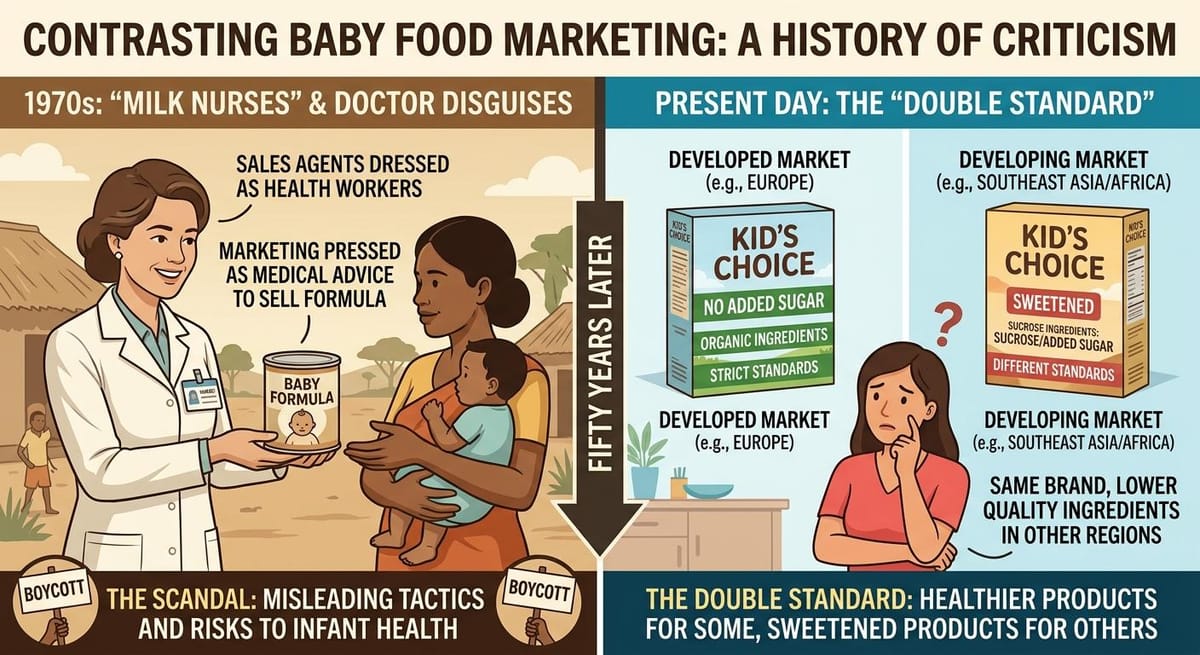
Nestlé had spent the previous decade building the market the code was trying to regulate — not through better products, but through saleswomen in nurses' uniforms who told new mothers, some of them illiterate, that formula was scientifically superior to their own milk, then gave it to them for free until the mothers' own supply had dried up and they had no choice but to start buying it.
The Milk Nurses
Nestlé's "mothercraft nurses" — sometimes with no medical training at all — visited maternity wards and new mothers' homes across Africa, Asia, and Latin America through the 1960s and 70s, distributing free formula samples and instructing mothers on preparation. Once breastfeeding stopped from disuse, the free samples ran out and families that often couldn't read the mixing instructions, or afford enough formula to follow them, or access clean water to prepare it with, were locked into a product that could no longer be substituted for what it had replaced.
The Baby Killer Trial
- 1974: The British charity War on Want publishes "The Baby Killer," a report accusing Nestlé of causing infant illness and death in developing countries through its formula marketing.
- The Swiss group Arbeitsgruppe Dritte Welt translates the report into German under the title "Nestlé tötet Babys" — Nestlé Kills Babies.
- Nestlé sues the translators for libel in a Bern court.
- 1976: Judge Jürg Sollberger convicts the defendants on one narrow technical count and fines them a token amount — but rules that Nestlé's advertising practices bore real responsibility for infant illness and death, and tells the company in open court that if it wants to avoid the accusation of killing babies in the future, it will have to fundamentally change how it markets formula. Time magazine calls it a moral victory for the defense.
The Boycott and the Code
Nestlé did not fundamentally change how it marketed formula. A U.S. boycott of Nestlé products launched on July 4, 1977, spread to Europe by the early 1980s, and ran for seven years. In 1979, the World Health Organization and UNICEF convened a meeting on regulating breast-milk substitute marketing, which produced the International Code of Marketing of Breast-milk Substitutes — adopted by the World Health Assembly in 1981 on that 118-to-1 vote, restricting free samples, advertising claims, and the use of health-worker imagery to sell formula. Nestlé announced it would comply. The International Baby Food Action Network, IBFAN, was founded that same year specifically to monitor whether companies actually did.
What the Numbers Say
In 2018, economists Jesse Anttila-Hughes, Lia Fernald, Paul Gertler, Patrick Krause, Eleanor Tsai, and Bruce Wydick published a working paper through the National Bureau of Economic Research that tried to measure the marketing campaign's cost in lives, using birth records from more than 2.6 million infants across 38 countries matched against Nestlé's own historical market-entry data. They found infant mortality rose by 19.4 per thousand births — a 27 percent increase — in households without access to clean water following Nestlé's entry into a market, and no measurable effect in households that already had clean water. At the boycott's peak in 1981, the paper estimates that translated to roughly 212,000 excess infant deaths that year.
The Double Standard Never Left
In April 2024, the Swiss investigative group Public Eye and IBFAN published lab results on two of Nestlé's best-selling baby food lines, Cerelac infant cereal and Nido toddler milk, sold across Africa, Asia, and Latin America.
- 108 of 115 Cerelac products tested — 94 percent — contained added sugar, despite WHO guidelines recommending none for products marketed to infants and young children.
- 21 of 29 Nido products tested — 72 percent — also contained added sugar.
- A serving of Cerelac sold in the Philippines for babies aged one to six months contained 7.3 grams of added sugar; a serving sold in Senegal and South Africa contained 6 grams.
- The same Cerelac product sold in Nestlé's home market, Switzerland, is labeled "no added sugar."
Nestlé's public response, quoted in multiple outlets covering the report, was that it had already been reducing added sugars in its infant cereal range globally and would continue to do so.
The company that a Swiss judge told to change its marketing in 1976 is, as of 2024, still selling a version of the same product with sugar removed for the country that watched the trial, and sugar left in for the countries that didn't.
Filed from public reporting:
- Baby Milk Action — Remembering the Baby Killer Booklet and Nestlé Libel Trial
- Global Nonviolent Action Database — International Groups Boycott Nestle Products to End Indiscriminate Advertising, 1977–1984
- Wikipedia — 1977 Nestlé Boycott
- Wikipedia — International Baby Food Action Network
- National Bureau of Economic Research — Mortality from Nestlé's Marketing of Infant Formula in Low and Middle-Income Countries
- Public Eye — How Nestlé Gets Children Hooked on Sugar in Lower-Income Countries
- IBFAN — How Nestlé Gets Children Hooked on Sugar in Lower-Income Countries
- The Washington Post — Nestlé Adds Sugar to Baby Food in Poorer Countries, Report Finds
- Time — Nestlé Adds Sugar to Baby Milk and Cereal in Poorer Nations
- NBC News — Report Finds Nestlé Adds Sugars to Baby Food in Low-Income Countries
- Business & Human Rights Resource Centre — Nestlé Adds Sugar to Baby-Food Sold in Poorer Countries, NGO Report Alleges


