Saloons Gave Away Lunch With Every Beer for 80 Years. It Took Two City Bans and Prohibition to Stop It.

Share
Saloons Gave Away Lunch With Every Beer for 80 Years. It Took Two City Bans and Prohibition to Stop It.
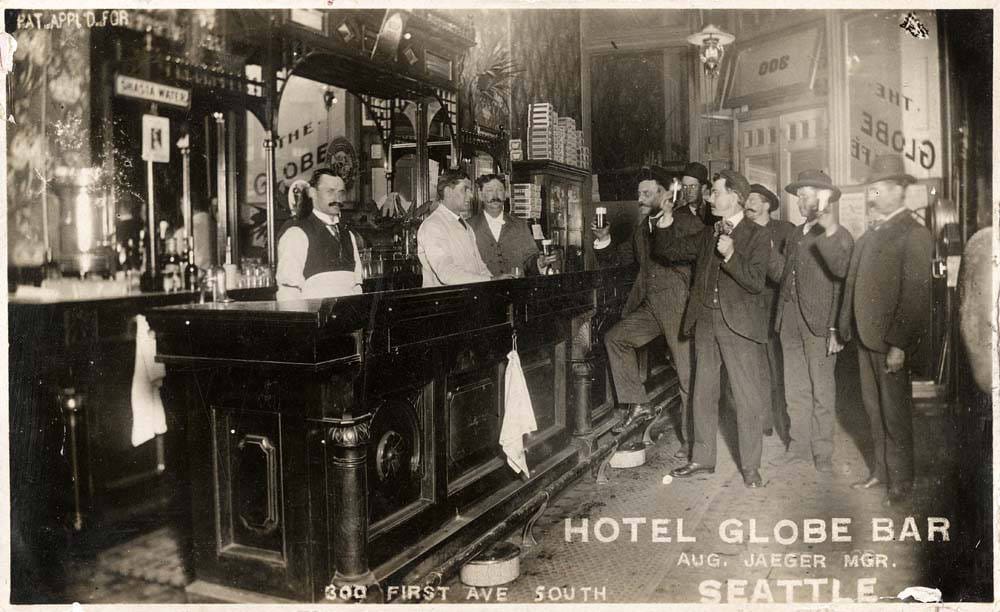
Bartenders and patrons at the bar of the Hotel Globe, Seattle, circa 1910. Photo: MOHAI, Wikimedia Commons, Public domain.

For roughly eighty years, the price of lunch in most American cities was one nickel beer. Saloons piled out spreads of oysters, roasts, cheese, and bread under the "free lunch" banner, on the understanding that a man who bought one drink would probably buy several more before he left. It was a good bet. It was not a bet the industry could keep making forever.

Born in New Orleans, Perfected Everywhere Else

The practice traces to 1838, at Maspero's Exchange in New Orleans, and spread into a genuine institution: by the 1890s, Chicago had 115 saloons running free lunches along a single four-mile stretch, against only five paid restaurants trying to compete with them. Brewers supplied the food to saloonkeepers at cost, confident the beer would more than cover it. In Springfield, Illinois, Conrad Beyer's saloon was locally famous for having the best free lunch in town — a marketing strategy built entirely on giving food away.

The Free Lunch Fiend Was a Known Quantity

Saloon culture had a name for the customer who took the arithmetic too literally: the "free lunch fiend." An 1872 New York Times item on "loafers and free-lunch men" already treated the type as an established nuisance, not a new one. He bought the cheapest drink on the menu — or, depending who was telling the story, none at all — and ate a spread that would have cost a full dollar at an actual restaurant. Saloonkeepers tolerated him for decades, the same way any business tolerates a small, familiar leak: he was cheap compared to the four other men at the bar who kept ordering.

Milwaukee, 1912: A Fight Over the Liverwurst

The arithmetic stopped being a private matter for good in July 1912, at Fred Smith's saloon on Milwaukee's 30th and Clarke. A patron named Alexander Polatsch got into a physical altercation with Smith over how he was eating the free liverwurst; a patrolman hauled him in for disorderly conduct, and Judge Neelen fined him $10 plus costs with a line that made the local papers for three straight days: "I wouldn't eat any free lunch if I was starving. If a man is hungry he ought to buy a lunch." It was a small courtroom story about one plate of liverwurst. It was also, in hindsight, the sound of the industry's patience running out in public.

Everyone Lost the Lunch, Not Just the Fiends

By 1909 the trade press was already discussing city ordinances to end free lunch outright — not to shrink the portions, but to abolish the practice entirely. Chicago banned it in 1913. Pennsylvania banned it statewide in 1917. Saloonkeeper spokesman Michael Montague tried to defend it to Chicago's licensing board that same year, arguing free lunch actually reduced drinking by giving men a reason to stay sober enough to keep tabbing beers — and lost. National Prohibition in 1920 finished off whatever saloons the local bans hadn't already caught, and when saloons reopened after repeal in 1933, the free lunch never came back with them. The man who bought four rounds a night lost his lunch at exactly the same moment as the fiend who bought one.


Filed from public reporting:

Read more

A Hand-Tightened Blind Flange and a Botched Shift Handover Killed 167 Men on Occidental Petroleum's Piper Alpha Platform in 22 Minutes. No One at the Company Was Ever Criminally Charged.

A Hand-Tightened Blind Flange and a Botched Shift Handover Killed 167 Men on Occidental Petroleum's Piper Alpha Platform in 22 Minutes. No One at the Company Was Ever Criminally Charged.

At around 10 p.m. on July 6, 1988, a pressure safety valve that had been pulled for maintenance that morning let gas condensate leak past a blind flange that had only been hand-tightened. Within 22 minutes, the Piper Alpha platform, 120 miles northeast of Aberdeen in the North

By The Complaints Department
Netflix Spent Six Years Telling Customers Love Is Sharing a Password. Once It Started Charging $7.99 a Month Per Shared Password Instead, Subscriber Growth Hit Its Best Year Since the Pandemic.

Netflix Spent Six Years Telling Customers Love Is Sharing a Password. Once It Started Charging $7.99 a Month Per Shared Password Instead, Subscriber Growth Hit Its Best Year Since the Pandemic.

On March 10, 2017, Netflix's official Twitter account posted four words that would follow the company around for the next six years: "Love is sharing a password." It was a promo tweet for a show called Love, but it was also, unmistakably, a policy statement — an

By The Complaints Department
New York Paused Congestion Pricing for 'Affordability' Weeks Before a 2024 Election, Then Relaunched It at a Lower Price Once Voting Was Over. A Year Later, Traffic Was Down 11 Percent and the Federal Government Was Still in Court Trying to Kill It.

New York Paused Congestion Pricing for 'Affordability' Weeks Before a 2024 Election, Then Relaunched It at a Lower Price Once Voting Was Over. A Year Later, Traffic Was Down 11 Percent and the Federal Government Was Still in Court Trying to Kill It.

On June 5, 2024, Governor Kathy Hochul stood before reporters and "indefinitely paused" New York's Central Business District Tolling Program, the long-planned congestion charge for driving into Manhattan below 60th Street. The launch was three weeks away. Hochul cited affordability concerns for working- and middle-

By The Complaints Department
Twitter Cut Off the Third-Party Apps That Built Its Developer Ecosystem in January 2023 With No Warning. One of Those Apps Coined the Word Tweet and Designed Twitter's Bird Logo Before Twitter Had Either.

Twitter Cut Off the Third-Party Apps That Built Its Developer Ecosystem in January 2023 With No Warning. One of Those Apps Coined the Word Tweet and Designed Twitter's Bird Logo Before Twitter Had Either.

On January 13, 2023, Twitter's API went dark for third-party client apps with no announcement and no explanation. Tweetbot, Twitterrific, Fenix, and others simply stopped working, all at once, for everyone. Developers spent days guessing whether it was a bug, an outage, or deliberate. Four days later,

By The Complaints Department