The Sugar Industry Paid Harvard to Blame Fat for Heart Disease. The Food Pyramid Never Recovered.
Underneath the glossy "MyPlate" graphics lies a paper trail of sugar cartels buying off Harvard researchers, the cattle and dairy lobbies throwing million-dollar tantrums to redesign government graphics, and politicians frantically redlining their own reports to appease the meat industry.

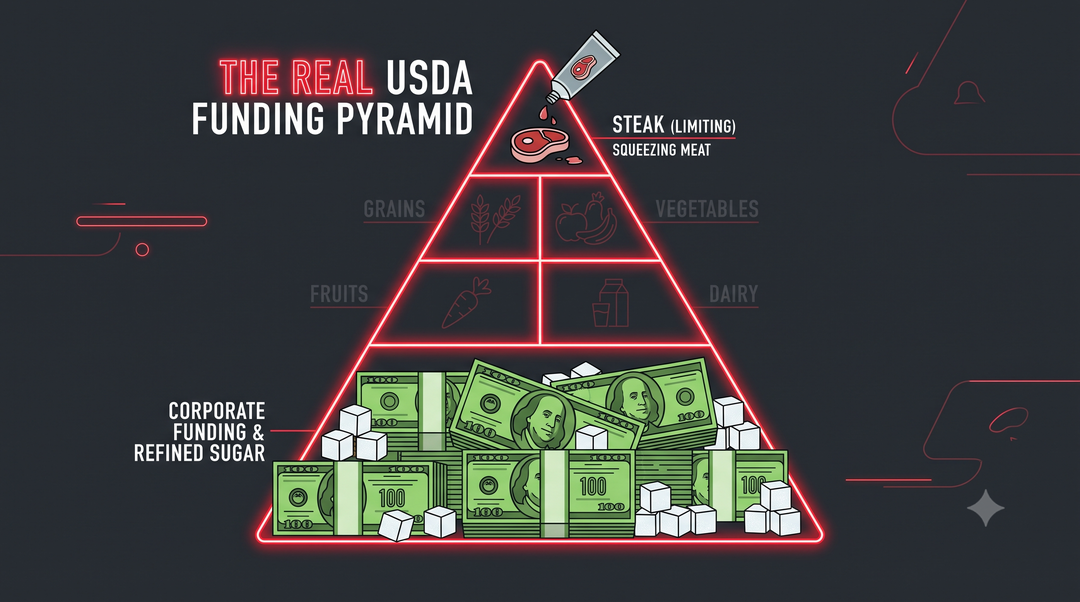
For over three decades, the USDA has graciously informed Americans that the foundation of a healthy life is a giant, starchy pile of grains, punctuated by a suspiciously small corner for actual protein. Every iteration of this dietary guidance has been presented as the immaculate conception of neutral, benevolent science.
Spoiler alert: It wasn't. The great American food chart isn’t a medical document—it’s a receipt.
Underneath the glossy "MyPlate" graphics lies a paper trail of sugar cartels buying off Harvard researchers, the cattle and dairy lobbies throwing million-dollar tantrums to redesign government graphics, and politicians frantically redlining their own reports to appease the meat industry. All the while, a separate, much quieter body of evolutionary and anatomical research has been screaming that humans are built to eat meat, and the very plants the government pushes on us are waging microscopic chemical warfare against our guts.
Harvard’s $48,000 Sugar Rush
In 1965, the Sugar Research Foundation—the sugar industry's own trade group—realized they had a PR problem. People were starting to notice that sucrose might be linked to coronary heart disease. So, they did what any self-respecting industry does: they bought Harvard.
For the modern equivalent of roughly $48,000, they paid three Harvard nutritionists (Fredrick Stare, Mark Hegsted, and Robert McGandy) to produce a "literature review." The Foundation handpicked the studies, reviewed the drafts before publication, and got exactly the conclusion they paid for. The resulting 1967 two-part review in the New England Journal of Medicine miraculously exonerated sugar, instead pointing the finger squarely at dietary fat and cholesterol.
None of the funding was disclosed. Hegsted, having proven his loyalty to the checkbook, was later rewarded by helping write the USDA's first official dietary guidelines in 1977.
Meanwhile, British nutritionist John Yudkin spent the 1960s and 70s screaming from the rooftops that sugar, not fat, was the real driver of heart disease. For the crime of being right too early, he was publicly discredited, his funding dried up, and his career was ruined before his death in 1995.
The Pyramid Built by Cattlemen and Lobbyists
By April 1991, the USDA had a completed "Eating Right Pyramid" ready for the public. But wait! The National Cattlemen's Association and the National Milk Producers Federation threw an absolute fit. Why? Because their precious meat and dairy products were placed uncomfortably close to the "fats and sweets" tip at the top.
The USDA obediently pulled the release at the last minute. It took a full year and nearly $900,000 of taxpayer money to reshape the graphic exactly how the industry wanted it before the final, compromised pyramid was released in 1992. As Marion Nestle has documented for decades, the USDA is legally required to do two jobs: promote American agricultural products and tell Americans what to eat. Guess which job pays the bills?
The Senate Report That Got Butchered
In January 1977, Senator George McGovern's Select Committee on Nutrition released the "Dietary Goals for the United States," which bluntly told Americans to "eat less meat."
The meat, egg, and dairy industries pushed back so aggressively that the committee literally held more hearings just to soften the language. By the end of the year, the blunt "eat less meat" instruction was erased, replaced with softer, focus-grouped nonsense about choosing meats that reduce saturated fat. The committee was disbanded shortly after. The founding text of American dietary advice was literally edited in real-time by the industry it was warning us about.
The Inconvenient Anatomy (Or: Why You Aren't a Gorilla)
While the committees were busy drawing up wedges of grain, they conveniently ignored human anatomy. A 2021 review in the American Journal of Physical Anthropology confirms what the fossil record proves: the genus Homo functioned at a high, carnivorous trophic level for most of the last two million years. Stable nitrogen isotope studies show our ancestors were apex predators with a higher carnivore rating than lions and hyenas.
Our bodies are screaming this reality. We don't have the flat, millstone teeth of a cow to grind fibrous mush from side to side—we have bicuspid teeth. Our stomach pH sits at a hyper-acidic 1.5, matching the acidity of scavengers adapted to dissolve high bacterial loads on raw meat.
What we don't have is a massive cecum to ferment fiber into short-chain fatty acids like a gorilla does. Our appendix is just a shriveled, vestigial ghost of an organ that gave up millions of years ago because we stopped needing it. The moment our ancestors figured out how to hunt megafauna, our brain size exploded. The moment we invented agriculture and started eating grain, our brain size shrunk and crooked teeth became the norm. Yet the USDA wants you to believe you're a grazing herbivore.
The "Edible" Poison
Here's the fun part the food pyramid conveniently omits: plants are alive, and they don't want to be eaten. Animals can run or fight; plants use chemical warfare.
Brussels sprouts contain over 130 known human carcinogens. Almonds contain cyanide, kept safely locked away until their "crush mechanism" is triggered by your chewing, at which point they release a poison pill. Wheat and soy pack protease inhibitors that actively block your body from absorbing protein.
But sure, make them the base of your diet. Fiber—that magical roughage we're told we need—is quite literally indigestible waste. It acts as a physical barrier blocking nutrient absorption, causes micro-abrasions in your gut lining, and gets frantically pushed out of your body because your system wants absolutely nothing to do with it. If a low-residue (low-fiber) diet is the first thing surgeons prescribe to heal a diseased bowel, why is stuffing it full of indigestible, abrasive roughage the standard advice for a healthy one?
The current federal "MyPlate" is not a triumph of nutritional science. It is a negotiated settlement between government agencies and the industries they were supposed to regulate. The actual science has been sitting in the public archive for fifty years—but there’s simply no money in telling people to just eat a steak.
Filed from public reporting:
- JAMA Internal Medicine — Sugar Industry and Coronary Heart Disease Research: A Historical Analysis of Internal Industry Documents (2016)
- The New York Times — How the Sugar Industry Shifted Blame to Fat
- PBS Frontline — Diet Wars: The Food Pyramid
- American Journal of Public Health — McGovern's Senate Select Committee on Nutrition and Human Needs Versus the Meat Industry on the Diet-Heart Question (2014)
- The Guardian — The Sugar Conspiracy
- Time — Experts Say Lobbying Skewed the U.S. Dietary Guidelines
- American Journal of Physical Anthropology — The Evolution of the Human Trophic Level During the Pleistocene (2021)
- Why We Are Carnivores Slide Presentation, with Dr Anthony Chaffee


