A Robot Made From a Bucket and Pool Noodles Hitchhiked Across Canada, Germany and the Netherlands on the Kindness of Strangers. Two Weeks Into Its American Tour It Was Found Without Its Head in Philadelphia.

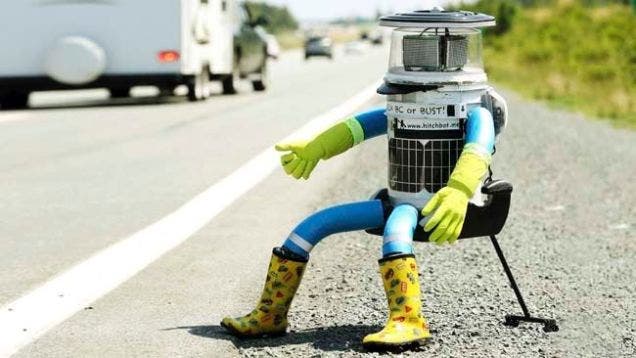
In 2013, Frauke Zeller, a professor of professional communication at Ryerson University in Toronto, and her husband David Harris Smith, a professor of communication studies at McMaster University in Hamilton, designed a robot that could not move. It had a plastic bucket for a body, pool noodles for arms and legs, yellow gardening gloves, Wellington boots, a child's booster seat and an LED face inside a cake saver. It could raise one arm into a hitchhiking position, and that was the full extent of its mobility. It could hold a limited conversation, recite factoids, report its position by GPS and take a photograph about every 20 minutes. It was called hitchBOT, and it went wherever strangers chose to carry it.
The point was the premise. "Usually, we are concerned with whether we can trust robots," Zeller said in a July 2014 news release. "This project asks: can robots trust human beings?" Writing later in the journal Leonardo, the pair described the project as "inverting the popular dystopian question." The Canadian Encyclopedia records that they gave it what they called a "yard-sale aesthetic." A French theatre listing later explained that the cheap materials were chosen so as not to tempt thieves. At three feet and about 25 pounds, it was light enough to lift into a car and heavy enough not to blow off the shoulder of the road.
The Trans-Canada
On 27 July 2014, hitchBOT was set down at the roadside in Halifax, Nova Scotia. According to the Canada Science and Technology Museum, it reached Victoria, British Columbia, 26 days later, having travelled more than 10,000 kilometres in 19 rides. NBC News reported that residents gave it a ceremonial canoe greeting in Victoria Harbour, followed by an official homecoming on 21 August at the city's Open Space Gallery. Along the way it went camping with a couple in Halifax and attended a powwow at Wiikwemkoong Unceded Territory on Manitoulin Island, where it was given a name in Anishinaabemowin meaning "Iron Woman." An Air Canada pilot gave it a set of pilot wings on the flight home.
The robot came back covered in signatures, stickers, jewellery and drawings. "HitchBOT is kind of like a space shuttle," Smith told NBC. "A lot of markings, people have signed it. It has this aura, originality, authenticity, and has actually developed a kind of value." Zeller told The Eyeopener, Ryerson's student newspaper, that it had come back "transformed," and that the team wanted to preserve it. The researchers therefore built a second robot for travel abroad, with the same look, an icon to show when it needed charging and upgraded language software. The Eyeopener called it hitchBOT 2.0.
The European Leg
In February 2015 the new robot spent ten days in Germany, followed by a camera crew from the broadcaster ProSieben. It visited Neuschwanstein Castle, rode on a float in the Cologne Carnival and was photographed with Canadian embassy staff at the Brandenburg Gate. In June it spent three weeks in the Twente region of the Netherlands, where it visited art museums, had its portrait drawn and conducted a band at the Kulturhus in Borne. Before the first trip, Zeller said, people kept asking whether the team worried something would happen to it. The team's answer was that the risk was part of the experiment. By the summer of 2015 the robot had been treated so well, she later told The Eyeopener, that she was not worried about sending it to the United States.
The American tour began on 17 July 2015 in Massachusetts, with "San Francisco or bust" taped across its head. Strangers took it around Boston, Salem, Gloucester and Marblehead, briefly out to sea, and to a Red Sox game at Fenway Park, where it did the wave, ticking off one item on a bucket list its creators had published. It then went on to New York and crossed off another: "See the lights in Times Square." The rest of the list included Mount Rushmore and the Grand Canyon.
Elfreth's Alley
The robot reached Philadelphia at the end of July. At about 1:30 a.m. on Saturday 1 August, according to the Philadelphia Daily News, it was collected from the steps of the Philadelphia Museum of Art by Jesse Wellens and Ed Bassmaster, two YouTube video bloggers who make their living recording pranks. Their video shows the robot in the back seat of their pickup announcing "We are around Philadelphia," and then the three of them on a bench at the entrance to Elfreth's Alley, the oldest continuously inhabited residential street in the country. A taxi to Washington would have cost about $350, so they left it there for someone else. Wellens tweeted the drop-off at 3:57 a.m.
Later that day someone sent the research team a photograph of the robot without its head, its arms torn off and lying beside it. "They sent us images and it's really beyond repair," the researchers told The Guardian, as quoted by Gizmodo. "There's not a single wire inside and all the things are broken." The battery was dead, so the GPS could not say where the remains were. The camera had taken no pictures of whoever did it. "They were lucky," one of the researchers said, "because it takes images every 20 minutes so it must have been in-between that interval." Before it went silent, hitchBOT's own accounts posted: "My trip must come to an end for now, but my love for humans will never fade."
The team's statement said the robot had been "vandalized overnight in Philadelphia; sometimes bad things happen to good robots," and that "this great experiment is not over." A second statement followed: "We have no interest in pressing charges or finding the people who vandalized hitchBOT; we wish to remember the good times, and we encourage hitchBOT's friends and fans to do the same." Officer Tanya Little, a police spokeswoman, told the Daily News that nobody had filed a report and that the police could not investigate vandalism without a report from the owner and a definite location. Detective Joe Murray offered a theory anyway: "I just think someone saw it, probably came out of a bar and was drunk and beat the crap out of it." Zeller told the Associated Press that her team would not release the last photograph, to protect young fans.
The Surveillance Footage
On Monday 3 August, Wellens posted what he said was security footage from Second Street at Elfreth's Alley. It showed a man in a No. 12 Eagles jersey kicking something on a bench, mostly hidden behind a bin, with pool-noodle limbs on the pavement and a time stamp of 5:45 a.m. Television news ran it as surveillance of the robot's final seconds. Matt Novak of Gizmodo observed that it "looks amateurishly staged, poorly acted, and has clearly been given artificial grain and distortion," and that no camera covered the street from that angle. The man in the jersey appeared to be Bassmaster, who that weekend had also performed a livestream as his character "Always Teste," insisting he knew nothing about the robot.
On Tuesday the pair posted the making-of. It showed Bassmaster standing on Wellens' shoulders to fix a camera to a city sign, an iPhone blinking on the bench, and replica arms of pool noodles and gardening gloves bought at Walmart. "Listen, we didn't kill the robot," Wellens said in the aisles. "We don't know who did it." The video's message was "Don't always trust the news!" Bassmaster's accompanying statement said: "Just to be clear we did not destroy the Robot. We just wanted to Prank the News to think 'Teste' did it." WHYY noted that the two men nonetheless had the last known contact with the robot. Gizmodo noted a tweet, deleted shortly after, from an account claiming a friend had "just picked up" the robot in Philadelphia with its head and electronics already gone. No one has been charged, identified or, as far as the public record shows, looked for.
Active Retirement
The city responded with a Kickstarter. A Philadelphia-area resident raised more than $1,600 against a goal of $1,200 to rebuild the robot, and The Hactory, a West Philadelphia makerspace, asked for donated tablets. Meryl Levitz, president of Visit Philadelphia, told PhillyVoice that things like this "don't make Philadelphia look good," but that the city would be no harder to sell. Smith told WHYY that the team had always known the robot might be damaged or stolen, and that it had learned "a lot about human empathy and trust." By January 2016 Zeller said the project was on hold: "It's not just some little project you can run on a small budget now."
In December 2015 the Canada Science and Technology Museum in Ottawa acquired the original robot, the one that had crossed Canada and come back covered in well-wishes, for its communications and computing collection. Its curator, Tom Everrett, said the museum did not want the arrangement "to be a funeral," and preferred to call it "active retirement." According to The Canadian Encyclopedia, a reconstructed hitchBOT was sent to France in 2019 for Killing Robots, a play by the director Linda Blanchet, billed in Lyon in February 2020 as an investigation into the first "roboticide" of modern history. The robot that trusted strangers across two continents now lives behind museum glass in Ottawa. The one sent to Philadelphia became the subject of a stage whodunit, and The Canadian Encyclopedia, writing a decade after the event, records that the culprits remain unknown.
Filed from public reporting:
- Associated Press via The Christian Science Monitor — "Hitchhiking robot's cross-country trip in US ends in Philly"
- NPR via GBH — "A Hitchhiking Robot's Journey West Ends Early ... In Philadelphia"
- Philadelphia Daily News — "Traveling Canadian robot destroyed in Philly"
- The Philadelphia Inquirer — "What happened to hitchBOT? No answers, only speculation."
- Gizmodo — "Vloggers Faked a Surveillance Video, But Did They Destroy hitchBOT?"
- WHYY — "Philly pranksters admit hitchBOT video was hoax, but say they didn't dismember him [video]"
- PhillyVoice — "Philly techies trying to revive hitchBOT"
- NBC News — "Welcome Home! Hitchhiking Robot's Cross-Canada Journey a Success"
- Ingenium — "Canada Science and Technology Museum Acquires hitchBOT"
- The Eyeopener — "HitchBOT retiring in Ottawa museum"
- The Canadian Encyclopedia — "hitchBOT"
- Fréquence Sud — "Killing Robots"
- Lyon Capitale — "Lyon : Au TNG, l'avenir c'est maintenant"


